Showing posts with label social media marketing. Show all posts

Wednesday, October 31, 2012

Who's Got The Power?

Like millions of other Americans, I am an avid user of social media. I use Facebook on a daily basis, and also belong to Twitter and Pinterest, among others. I use these outlets to keep in touch with friends from high school who I haven't seen in years, friends who have moved away, and even friends who I see on a regular basis. It's an easy way to quickly connect, even easier than a phone call or a text (sometimes!)

Although I "like" some companies like Target, Bath and Body Works and The Gap on Facebook or follow their Twitter feeds, before this course I never really took into account not only the impact social media has on the way that companies communicate, market and advertise to consumers, but the way that the groundswell has shifted power from these companies to the consumers.

In Chapter 11 of Li and Bernoff's Groundswell, they give a perfect example of the power shifting back to consumers because of the groundswell. They share the story of Jeff Jarvis, a journalist and blogger, who shared on his blog the frustration he was feeling with the computer company, Dell. He twice recieved a defective computer and felt that the company wasn't listening to him. Jarvis wrote on his blog:
"Is anyone at Dell listening?...We are in a new era of 'seller beware'. Now when you
screw your customers, your customers can fight back, publish and organize."
 
Dell had a major problem on it's hands. People were taking to social media to trade Dell horror stories, complain about lack of customer service and shoddy computers, and negative attitudes towards Dell were never higher.
 

But then Dell did something many companies fail to do--they took the time to listen. Dell monitored blogs and their own company forms, then started their own blog to address customer concerns. Without the power of the groundswell, it would have been more difficult for the consumer's message to reach Dell.


Another interesting example Li and Bernoff give about power shifting back to the "little people" so to speak, is Best Buy's Blue Shirt Nation.


Blue Shirt Nation was a social media set up by Best Buy exclusively for it's employees. It allowed them to connect with other employees, support each other and also allowed for employees to share their thoughts with the company about how to improve Best Buy.  When Best Buy reduced their employee discount, employees immediately took to Blue Shirt Nation to protest. There was such an overwhelming response from employees, who organized to show their displeasure, that Best Buy reversed their decision and kept the employee discount as is. Without the groundswell, employees of Best Buy would have had a much harder time making such a big impact. Organizing, banding together with stores all across the country would have taken much more time and effort. Using Blue Shirt Nation to their advantage, they were able to make a difference and a change.

Reading Groundswell has made me think quite a bit about the company I work for and Facebook. I am a manager for an early childhood center that has 10 locations across Massachusetts. The company does have a Facebook page that they use to communicate with parents about events, closings and to share general information about the schools. However, employees are discouraged from posting on the schools' Facebook page, responding to their status updates, or even 'liking' their statuses. In fact, today management received an e-mail from corporate asking us to look at the company's Facebook page and see if any teachers from our individual schools commented on recent updates and to speak to them about it.

Perhaps my employers know the power of social media--and how it's given power back to the people. And that, as Best Buy and Dell found out--people can use it bring about change. Something I guess they're just not ready for.


Monday, October 22, 2012

Monitoring Old Navy In The Groundswell

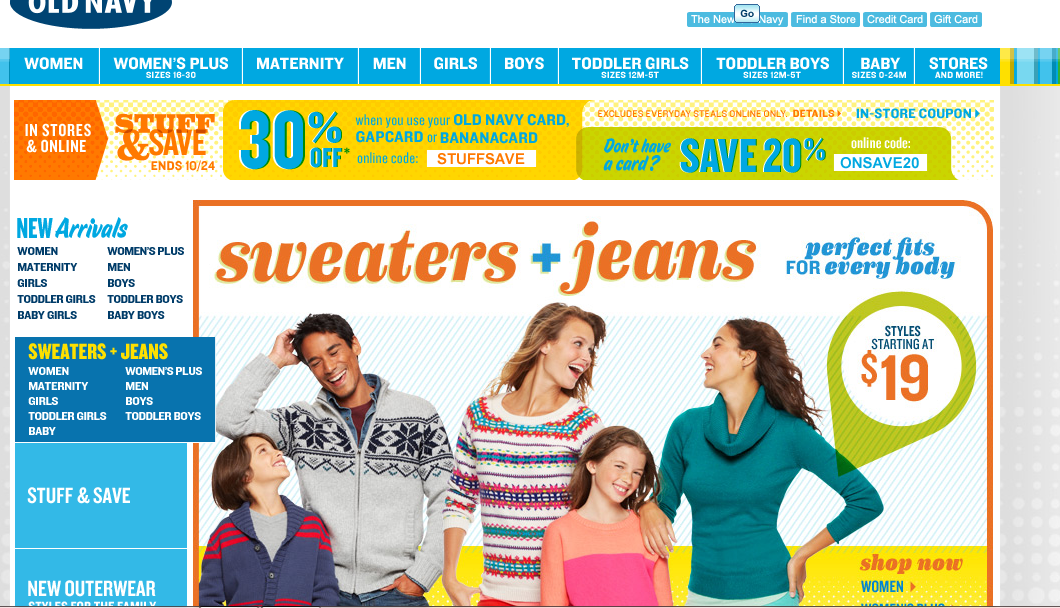
I've been shopping at Old Navy for as long as I can remember. I'm a fan of Old Navy because they have comfortable and reasonably priced clothes--I can buy nice clothes for work and still stay on a budget. Old Navy is a division of The Gap, Inc. and it's first stores opened in 1994. Their clothing is more affordable than their other Gap, Inc. counterparts (Gap, Banana Republic). Their target market is primarily price concious teenage girls and women. Old Navy sells clothes for women, men, infants, toddlers and children, as well as maternity wear.

Old Navy has always had creative commercials and advertising, but I ultimately decided to follow them for this project because of this commercial that recently aired over the summer:


The commercial features Jennie Garth, Luke Perry and Jason Preistley from Beverly Hills, 90210--a hugely popular show from the 90's that I loved when I was younger. They also aired commercials featuring Jordan Knight from New Kids On The Block and another featuring The Backstreet Boys. It was an obvious attempt to grab the attention of 30-something women, and for me, it worked!


Over the past few weeks, I have been monitoring Old Navy's presense in social media. I used Social Mention, IceRocket, Google Insights, and Tweetstats, as well as monitoring their website, Twitter, Facebook and Pinterest accounts for activity.

- Old Navy has a strong presence in social media, and they use it heavily to promote and market products.

Old Navy's official Facebook page
Twitter


Pinterest
 
Old Navy's Youtube channel
Website

All of Old Navy's social media platforms have similar color schemes and imagery, but each have a different focus. The website and Facebook page seem to be more targeted towards families, while their Pinterest page is definitely more focused on teenagers and women. Which makes sense since most Pinterest users are women. Their Youtube channel almost exclusively features commercials and videos about recent promotions that Old Navy has sponsored.
 
Old Navy seems to understand the notion of building a community to create a buzz and excitement for their product by energizing the groundswell.
 
Most recently, Old Navy promised it's customers that once they hit 5 million fans on Facebook, users would receive a special surprise from the store. They asked their Facebook fans to "like" their page, and then share the video below with their friends to encourage them to like Old Navy's page as well.


Old Navy was successful in it's goal and they recently hit the 5 million fan mark, and shared this video.
 
 
Both videos show people coming together and being excited to go shop at Old Navy. And as you can see, they used their fans to create the actual coupon that was the gift for reaching 5 million fans.
 
This campaign has been going on since the end of September and ended October 9th when they reached their goal. During this time, there was a definite spike in blog mentions, according to Icerocket. But as soon as the goal was reached, there was a significant drop off in blog mentions. They've since made a recovery in mentions.


Google Trends also shows a significant spike in interest during the 5 million fan campaign.
 

Social Mention- October 8th-12th

 
October 15th-21st
 The information I gathered from Social Mention showed that there was a significant decrease in Old Navy's strength of discussion over 2 weeks, from 26% to 3%. However there was an increase in sentiment and passion and a reduction in reach. Most of the sentiment in both weeks was either postive or neutral and very little negativity in the mentions of Old Navy.
 
Old Navy also saw an increase in followers both on Facebook and Twitter, even beyond the 5 million fans campaign. According to Starcount, on October 22, 2012, Old Navy increased their Facebook fans by 14,836 and their Twitter followers by 33.
 
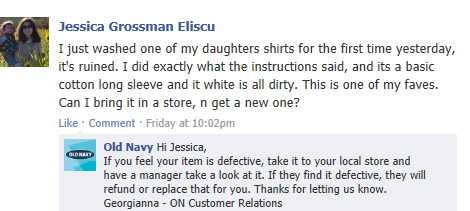
When taking a closer look at Old Navy's Facebook and Twitter pages, the company definitely takes the time to respond to most of it's posts from fans--especially the negative ones. However, most responses are rather generic and refer customers with concerns or complaints either to in-store managers or to call the customer service hotline.
 
Overall, most of the negative posts had to do with the quality of the clothing--or lack thereof. Many people complained that the clothing they had purchased had fallen apart soon after washing them. This is something that Old Navy needs to take heed of. If they develop a reputation of having cheap clothing, that would be something that would be difficult to bounce back from.


Most of the positive posts were about products customers liked or wanted to see more of. Those posts were rarely responded to.


Although it is important for Old Navy to reach out to disgruntled or unhappy customers, it is also important for them to make the happy customers feel appreciated, so that they will continue to be loyal to the Old Navy brand, and continue to leave the positive feedback that is so important to the company and it's reputation.
 
Most posts from Old Navy on it's Facebook page try to enage customers in discussions about their products. Each week, a new item is featured and feedback about the item is encouraged. Many of the posts also gave advice on how to wear the product or how to accessorize.
 

The Facebook page seems more like blatant advertising and doesn't seek to engage customers beyond showing a product. I think it would do Old Navy well to become a bit more personalized with it's customers.

Over the next few weeks, I want to continue to monitor Old Navy's social media accounts to see if they can sustain their recent success with their 5 million fan campaign. I will also be interested to see if the posts complaining about the quality of their clothing will increase or decrease, and I would also like to see if Old Navy is better able to engage their customers--particularly their target audience of teenage girls and women.


Wednesday, September 26, 2012

Facebook: Fail?

In Li and Bergnoff's Groundswell, they state that:
   "Listening is perhaps the most essential neglected skill in business. Part of the reason
is that it's always been so hard...In the era of groundswell, listening is easy. Not listening,
however, is criminal."
 
 
Social media has allowed businesses to connect with it's customers and potential customers like never before. Companies are able to introduce and promote new products just by posting on Facebook or Twitter. Social media also has allowed customers to communicate with businesses without having to call a 1-800 number and wait on hold for hours. Someone can post on a company's Facebook page with questions, comments or concerns and (hopefully) get a response from a company representative. Facebook and other social media has also give new power to consumers by allowing them to connect with each other and share their experiences with a company or product.
 
When businesses use social media to listen to their customers, it can be a wonderful thing for all involved. However, when a company is not savvy with their use of social media, or aren't in touch with the needs and wants of their clients, it can be an epic fail.
 
Take, for example, Chapstick. Now, normally Chapstick is not known for being controversial in any way...I mean, how can you make lip balm scandalous, really? But the people at Chapstick did find a way when they posted this ad on it's Facebook page:


An image of a a girl looking for her Chapstick behind the couch. There was an immediate and swift reaction from the internet. As soon as the image was posted, people started commenting on it's tastelessness, objecting to the ad. One blogger in particular was outraged enough to blog her disgust with the image. When she didn't get a response from Chapstick, she took her fight to their FAcebook page. As soon as she commented, Chapstick deleted it. Other Facebookers were finding the same thing--when they posted a comment that was negative about the ad, it was quickly deleted by the company. What was ironic--and pointed out by many a facebook commenter--is that at the bottom of every Chapstick ad it states: "Be heard at facebook.com/chapstick".
 
At first, Chapstick seemed to be trying to ignore the controversy, not responding at all to the wave of negativity. Eventually, they had no choice but to say something after they couldn't keep up with deleting every comment that came through. They issued an apology after it was made clear that the people would not be ignored.
 
 
Finally, in an interview with Adweek.com, Chapstick head of global media relations Ray Kerins said: "We're committed to listening. We're committed to the dialogue. This is a perfect example of listening to your followers, your fans. We're trying to live by those words."
 
Chapstick and many other companies have had to learn the hard way--if you don't do your research and learn your client base, social media is not going to work for you.  Li and Bergnoff point this out as well in Groundswell--do your homework, or Facebook will be an epic fail.


Wednesday, September 19, 2012

Memes: Not Just For Facebook?

In July 2012, at the London Olympic games, gymnast McKayla Maroney stunned the world with her perfect vault at the Women's Team Finals.


She was expected to take home the individual gold medal for the vault, but fell on her attempt and ended up taking home the silver. Maroney was visibly disappointed with her performance, and photographers around the world captured her expressions as she stood on the podium receiving her medal. Her so-called "unimpressed" face spawned an internet phenomenon in the form of the "McKayla Is Not Impressed" blog. The meme quickly became popular, with users inserting an unhappy McKayla Maroney into pictures or videos of current events, with the caption:"McKayla is not impressed".


These types of "memes"-An image, video, etc. that is passed electronically from one Internet user to another--- are becoming increasingly popular and common in social media, especially on Twitter, Facebook and Pinterest. Users can create their own memes, using sites like memegenerator.net or quickmeme.com. Most memes tend to be silly or humorous, but some use the medium to make social or political commentary.


Some mix humor and politics--such as the "Texts From Hillary" blog site.  The site started when Adam Smith and Stacy Lambe, who work in public relations in Washington D.C., took a picture that was published in Ocotober 2011 as Time magazine photo essay of Hillary Clinton as she awaited departure in a military plane and created this:


It quickly spread on the internet, and soon users were creating their own "Texts From Hillary" memes. Even Hillary Clinton herself got in on the deal, sending a meme of her own to the site.
 

The meme was picked up by major news outlets and no doubt gave Clinton a PR boost, showing that she has a sense of humor and can poke fun at herself and her image.

Companies have come to recognize the power and influence of memes, and have engaged in what some call "meme-jacking". Meme-jacking is when a company takes a popular meme and uses it to advertise their own product or idea. For example, one of the most popular Youtube videos recently has been the "Honey Badger" videos. Posted in January 2011 and with more than 45.8 million views to date, it features a documentary-style clip of a honey badger eating a king cobra with flamboyant narration from a man named "Randall".

Wonderful Pistachios snatched up the honey badger to run it's own  marketing campaign. The ads feature the honey badger using the infamous king cobra to crack open a pistachio.


Repeat offenders,Wonderful Pistachios also used another interenet meme, "Keyboard Cat" to push their pistachios to consumers.


In 2010, Old Spice ran a series of commercials called "The Man You Could Smell Like" featuring actor Isaiah Mustafa that became wildly popular.


To promote it's 2011 film, Puss In Boots, Dreamworks released a commercial featuring Puss as the "Old Spice Man".

Clearly, memes are powerful ways of communicating ideas, jokes, social and political commentary. Because of the immediacy and overwhelming influence of the internet, memes can spread quickly and become part of pop culture as easily as sharing something on Facebook. But companies should use caution when "meme-jacking"...people tire easily of these memes, and using them could backfire for them.

What do you think? Is using a meme a clever way to market to consumers, or a tired gimmick?